
Great Posters of the Great War
This online exhibit highlights French and American food rationing, temperance, and YMCA posters printed for the war effort. This site relies much on G.A. Rudolph’s catalogue War Posters from 1914 through 1918 in the Archives of the University of Nebraska-Lincoln, printed in 1990 for the University of Nebraska Studies series.
Unfortunately, while often a major point of scholarly interest, the history of this poster collection is largely unknown. As Rudolph notes, “no records remain to indicate the provenance of our World War I posters.” These pages are therefore both exhibit and call to further research.
Why “Great Posters?”
World War I is also known as the “Great War.”
But why are these Great War posters here called “Great Posters?”
Arguably for the first—and last—time, posters were the protagonists in American wartime propaganda. Though they would be used again, and in even greater numbers, during World War II, their impact would then be overshadowed by other media, notably the radio. As O.W. Riegel, propaganda analyst for the Office of War Information in WWII, notes in his introduction to Posters of World War I and World War II in the George C. Marshall Research Foundation, “It may not be excessive to say that the poster campaign involving all warring nations during World War I has never been equaled in its combination of magnitude and poster primacy for a single cause” (Riegel 3). During WWI, America and the American government depended on the poster for mass communication as they never had or would again.
The numbers and impact of the posters were themselves great. An estimated 2,000 to 3,000 posters were produced in America alone during the war, and printings of 100,000 “were not uncommon” (Riegel 3). According to Walton Rawls, more than twenty million American posters were printed, outstripping poster production in all other countries combined.
Many of posters are of great beauty and great fame. Arguably the best known American poster of all time, James Montgomery Flagg’s “I Want You for the U.S. Army” (1917) was initially printed for the Great War (though it would be printed again during WWII). Based on a British poster, Alfred Leete’s “Your Country Needs You” (1914; which depicts a heavily mustached man pointing directly at the passing viewer), Flagg’s version has, from its first printing to today, inspired thousands of offshoots and spoofs.
The artists who produced these posters, in the case of Charles Dana Gibson and his Division of Pictorial Publicity in particular, worked for free, with noble—great—and patriotic intentions. As architect Cass Gilbert “defined their mission: ‘To visualize to the people the facts of the great contest […] to place upon every wall in America the call to patriotism and to service” (Rawls 153). The Division “mustered nearly three thousand of America’s most famous artists into government service” (Rawls 147) and George Creel, who directed the greater Committee on Public Information of which the Division was a part, remembers that “even in the rush of the first days… I had the great conviction that the poster must play a great part in the fight for public opinion” (Rawls 150; emphasis added).
Food Posters
The food posters of World War I illustrate a serious European wartime problem: hunger. Starvation, as Walton Rawls argues in his Wake Up America! World War I and the American Poster, was a tactical weapon in this new kind of war. Even before the United States entered the fight, it was a major supplier of foodstuffs to the Allies and neutral nations. In 1917, for example, ninety percent of the wheat in Britain’s daily bread was American (Rawls 113).
In April 1917, Herbert Hoover, famous for his successful wartime work as the head of the Committee for Relief in Belgium, was appointed head of the new United States Food Administration. Often repeating “food will win the war,” Hoover believed that “second only to military action [food is] the dominate factor” (Rawls 112). Yet he was determined to keep American rationing voluntary. Arguably for this very reason, effective propaganda was even more crucial to the Food Administration’s success.
A small number of posters in this exhibit concern alcohol, and, indeed, the question of prohibition had been part of—and a problem for—food legislation since its wartime beginnings. “Temperance advocates,” as Maxcy Dickson chronicles in The Food Front in World War I, “immediately sought to incorporate national prohibition into the Food Control Bill” (Dickson 14). The issue was so divisive, however, that the bill could not pass with a national prohibition clause. In the end, only hard liquor manufacture was curtailed, and no American posters known to this author feature spirits, beer, or wine. The French posters, however, do not shy from the subject. Posters 130 and 184 openly call for the banning of alcohol. But French views were not uniform either, as shown by poster 240, which suggests that families “save wine for our poilus [“shaggies,” or “hairies,” a nickname for the often heavily-bearded French trench soldiers].”
Many of the French posters here pictured are drawn by schoolchildren. They are examples of winning entries in a national competition organized by the Comité National de Prévoyance et d’Economies. Children are often featured in propaganda—children and women are the innocents whose sufferings pull on the nation’s heartstrings most liberally—and one wonders if these child-drawn posters were indeed highly effective. Or, perhaps these posters are a sign of a new, total war—a war so total that even French children actively participated in and contributed to the war effort.
U.S. Food Administration Posters

Artist: Steele
Date: Undated
Creator: OC for the Food Administration
Dimensions: 54.8 x 35.3 cm
Item number: UNL poster 102
Text on poster: “Defeat the Kaiser and his U-Boats. Victory depends on which fails first, food or frightfulness. Eat less wheat.”
Artwork: Light tan, green, and orange text against black fill the poster’s lower half. The blackness extends into a silhouette of the Kaiser, whose face and helmet are shaded light green. In the background, smoke billows from a sinking ship against an orange sky and the black profile of a U-boat rises from the orange-toned sea.
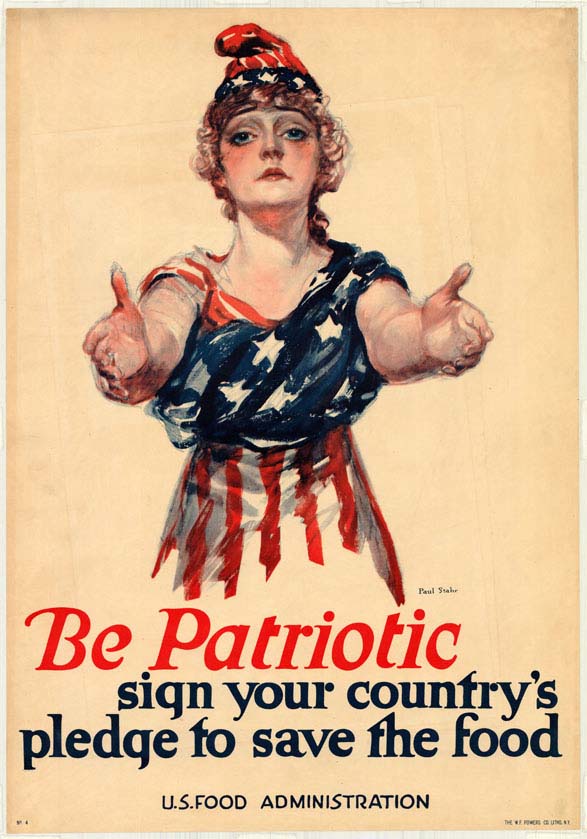
Artist: Paul Stahr
Date: 1917
Creator: The W.F. Powers Co. Litho. for the Food Administration, New York
Dimensions: 72.4 x 50.2 cm
Item number: UNL poster 268, Food Administration poster no. 4
Text on poster: “Be Patriotic. Sign your country’s pledge to save the food. U.S. Food Administration”
Artwork: On a tan background, a woman is depicted as reaching out her hands to the viewer. The woman is clothed in a dress with the American flag pattern, as well as wearing a hat that has the American flag pattern. Below “Be Patriotic” is written in large red text, underneath that “sign your country’s pledge to save the food. U.S. Food Administration” is written in slightly smaller black text.
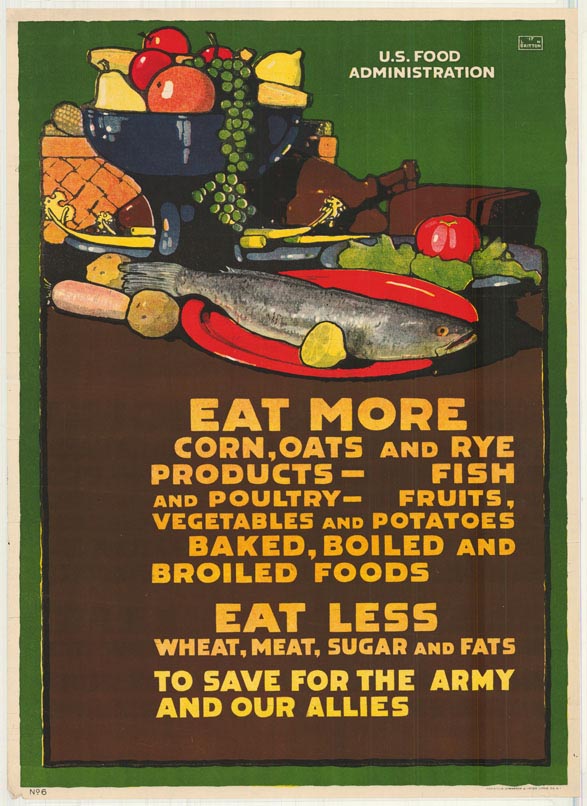
Artist: L.N. Britton
Date: 1917
Creator: Heywood Strasser and Voigt, New York
Dimensions: 72.4 x 52.6 cm
Item number: UNL poster 272, Food Administration poster no.6
Text on poster: “Eat more corn, oats and rye products – fish and poultry – fruts, vegetables and potatoes baked, boiled and broiled foods. Eat less wheat, meat, sugar and fats to save for the army and our allies.”
Artwork: On an earth green and brown background, images of an overflowing bowl filled with fruits, a red plate with a large silver colored fish, surrounded by potatoes, lemon, tomatoes, and lettuce are depicted in the top left corner. Below is large mustard yellow text.
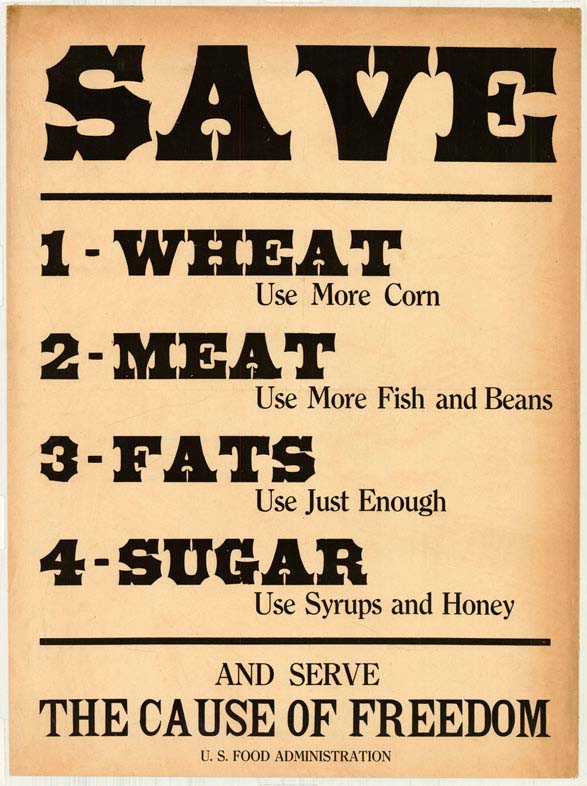
Date: 1917
Creator: Food Administration
Dimensions: 70.5 x 52 cm
Item number: UNL poster 290
Text on poster: “Save / and serve the cause of freedom. 1 – Wheat, use more corn. 2 – Meat, use more fish and beans. 3 – Fats, use just enough. 4 – Sugar, use syrups and Honey.”
Artwork: On a tan background large black text is depicted. “save” is on the top and “and serve the cause of freedom” is on the bottom. Underneath “save” is a black line, underneath which is additional text. Underneath this additional text is another black line above “and serve the cause of freedom.”
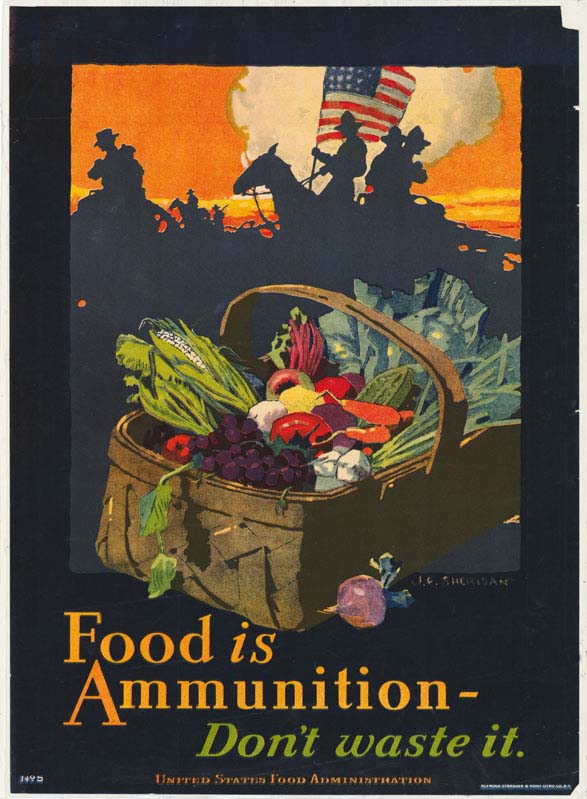
Date: 1917
Creator: Food Administration
Dimensions: 72.8 x 51.9 cm
Item number: UNL poster 278, Food Administration poster no. 5
Text on poster: “Food is ammunition – Don’t waste it.”
Artwork: In the background there are black silhouettes of men on horses. One silhouette is holding the American flag, which is depicted in full color in front of an orange sky. In front of these silhouettes is a brown woven basket filled with various kind of fruits and vegetables. Underneath, light orange and light green text is depicted.
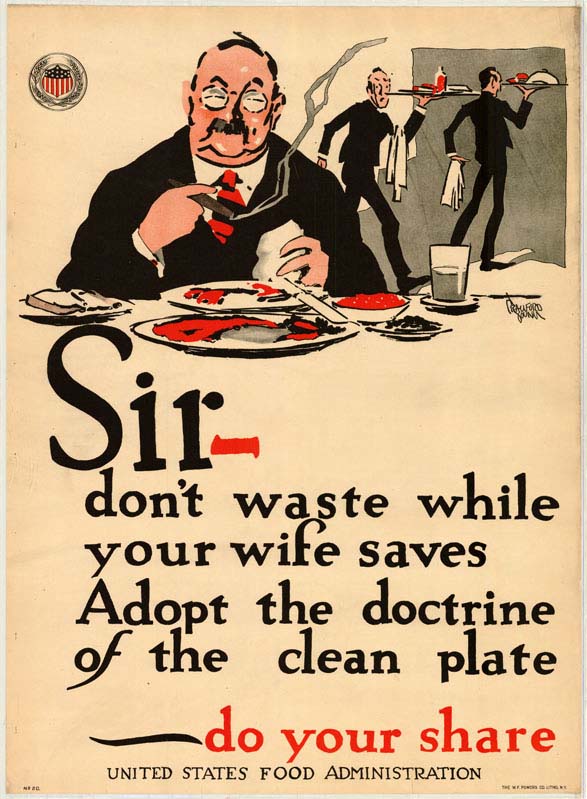
Date: 1918
Creator: The W.F. Powers Co. Litho for the Food Administration, New York
Dimensions: 73.3 x 53.6 cm
Item number: UNL poster 438, Food Administration poster no. 20
Text on poster: “Sire – don’t waste while your wife saves / Adopt the doctrine of the clean plate ~ do your share.”
Artwork: On the top of the poster an older man in a black suit with a red tie is depicted smoking a cigar with his right hand and holding a napkin in his left while sitting at a table. In front of him are two white plates with red and grey food. To the left there is another white plate with bread on it. To the right there is a white bowl with red food in it and a cup that is half full. Behind the man are two male servers carrying plates presumably into a restaurant kitchen. Below this illustration is black and red text.

Date: 1917
Creator: Food Administration, New York
Dimensions: 72.5 x 50.8 cm
Item number: UNL poster 277, Food Administration poster no. 1
Text on poster: “Food/ Don’t waste it. 1-buy it with though. 2-cook it with care. 3-use less wheat & meat. 4-buy local foods. 5-serve just enough. 5-use what is left.”
Artwork: On a tan background “Food” is written in large black text on the top of the poster along with “don’t waste it” on the bottom of the poster. In between are thick red lines where the rest of the text is depicted. The numbers are dashes are in red while the rest of the text is black.
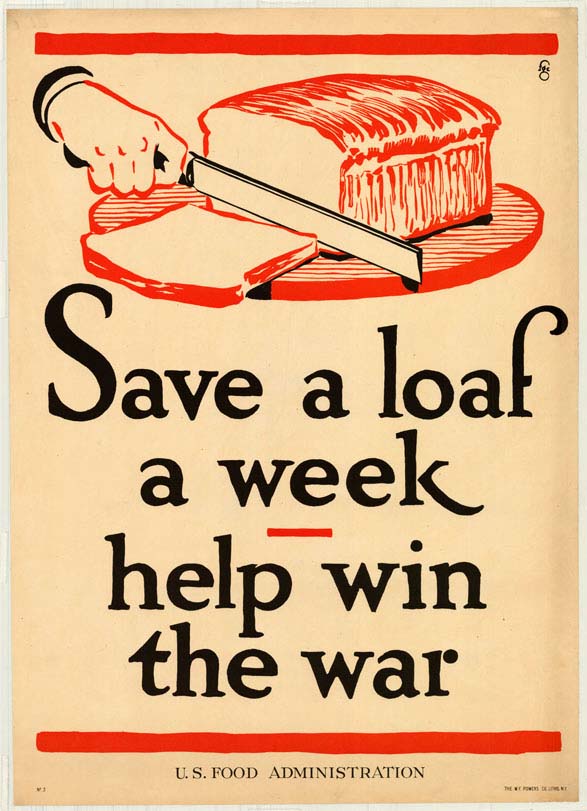
Date: 1917
Creator: The W.F. Powers Co. Litho. for the Food Administration, New York
Dimensions: 72.5 x 51.7 cm
Item number: UNL poster 288, Food Administration poster no. 3
Text on poster: “Save a loaf a week / help win the war.”
Artwork: On a cream background thick red lines are depicted on the top and bottom that act as a page border. On the top of the poster underneath the red line there is an outlined image of a red and black hand cutting a red loaf of bred with a black knife on top of a red plate. Underneath, the text is written in large black letters. “Save a loaf a week” and “help win the war” are separated by a small short red line.
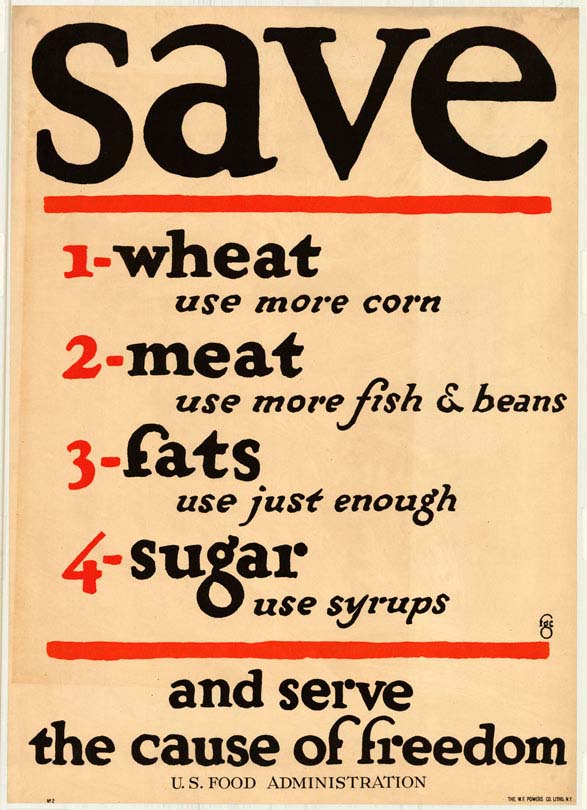
Date: 1917
Creator: The W.F. Powers Co. Litho. for the Food Administration, New York
Dimensions: 71.2 x 50.8 cm
Item number: UNL poster 289, Food Administration poster no. 2
Text on poster: “Save/ and serve the cause of freedom. 1-wheat, use more corn. 2-meat, use more fish & beans. 3-fats, use just enough. 4-sugar, use syrups.”
Artwork: On a tan background “save” is depicted in very large text on the top of the poster. Underneath is a thick red line. Underneath the line additional text is depicted, letters are in black and numbers and dashes are red. Underneath this text is another thick red line. On the bottom of the poster underneath the bottom red line “and serve the cause of freedom” is in large black font.

Date: 1918
Creator: Latham Litho. & Ptg. Co. for the Food Administration, Brooklyn
Dimensions: 70.5 x 51.8 cm
Item number: UNL poster 392, Food Administration poster no. 10
Text on poster: “Cardinal Mercier has appealed to the Food Administration for more food for starving millions. Eat less wheat-meat-fats and sugar. Ship more to the war-stricken people of France-Belgium-Italy.”
Artwork: A portrait from the shoulders up of Cardinal Mercier is depicted in the top middle portion of the poster. He is depicted with a white collar and red shirt over top. His hair is short and grey and he has a tan complexion. Underneath this portrait is black and red text. “Eat less wheat-meat-fats and sugar” is in red text as well as “France” Belgium” and “Italy.” The rest of the text is black.
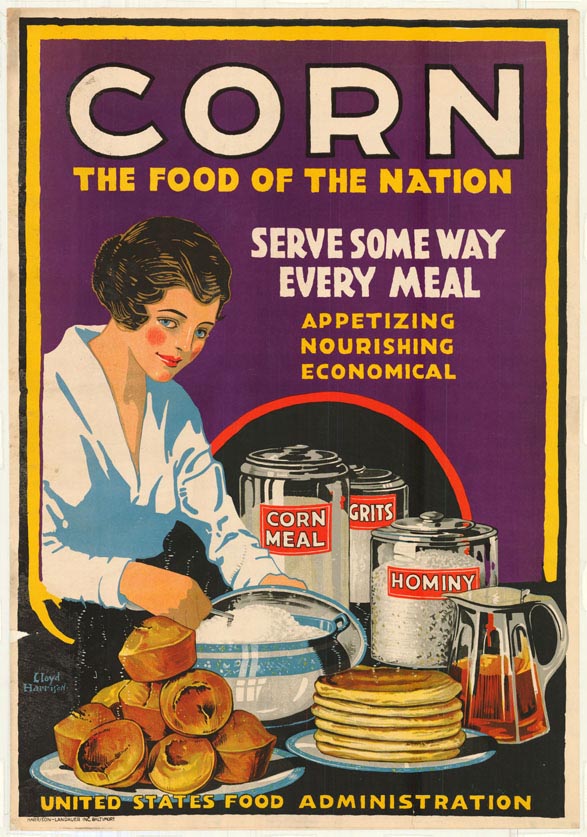
Date: 1918
Creator: Harrison-Landauer Inc. for the Food Administration, Baltimore
Dimensions: 75.6 x 52.3 cm
Item number: UNL poster 394
Text on poster: “Corn / the food of the nation. Serve someway every meal. Appetizing. Nourishing. Economical.”
Artwork: On a purple and yellow background that fades to black at the bottom, a white woman with short black hair, pink blush, and a white shirt is depicted on the left side. She stirring a mixture in a blue and white bowl. She is surrounded by corn muffins, pancakes (presumably made of corn), syrup, hominy, grits and corn meal. “Corn” and “Serve someway every meal” is depicted in white text. “The food of the nation” and “Appetizing. Nourishing. Economical” are depicted in yellow text.
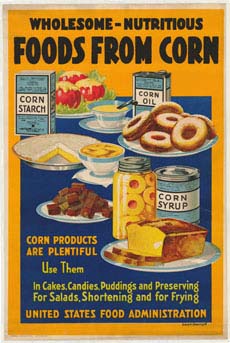
Date: Undated
Creator: Harrison-Landauer for the Food Administration, Baltimore
Dimensions: 75.1 x 50 cm
Item number: UNL poster 127
Text on poster: “Wholesome – Nutritious foods from corn. Corn products are plentiful. Use them in cakes, candies, puddings and preserving for salads, shortening, and for frying. United States Food Administration.”
Artwork: On a mustard and navy colored background, black, mustard, and light yellow text is depicted. Images of corn starch, corn oil, donuts, corn syrup, corn bread, cakes, salads, and preserves are depicted.

Date: 1918
Creator: The Carey Printing Co. for the Food Administration, New York
Dimensions: 74.1 x 50.5 cm
Item number: UNL poster 398, Food Administration poster no. 22
Text on Poster: “Food and the War! American Wheat to Win! ‘If food fails, we cannot hold out’ ‘Send food and we will win through’ Supplying food is America’s prime responsibility in the War right now. Food means, first of all, Wheat. The next two months will tell – Wheat is the Test! France, England, Italy and stricken Belgium stake their existence on American food resources-on her Wheat, above all. Coarse grains to mix in their war bread-corn, oats, rice, and other cereals-they need also. These we are sending-millions of bushels-and can continue to send from our surplus. Of wheat alone there is no surplus-we can send Wheat only as we save it. We must send it. Providing food to maintain the Allies is a national obligation that everyone of us pledged to redeem. Wheat is the Test. Thus far we have not saved enough. Month by month-week by week-because of various hindrances, we have sent overseas less than the needed quotas. Week by week-day by day- we have eaten into our reserve stock of wheat. There is no more leeway sow. We must save what we have hereafter, we must send henceforth all the Allies need. In our saving or selfishness is bound up success we collapse of the cause. Our saving or selfishness will be our triumph or shame. Wheat is the test. Food will win the War. Food at this season means, first of all, wheat. Russia crumpled in a food crisis; Italy wavered in dread of hunger. If food supplies fail, no flesh can stand against Germany’s war machine. America’s food resources alone can serve and defend the Allies. Wheat is the Test. Follow directions. Cut the use of Wheat to the limit. Households keep within an allowance of one and one-half pounds of wheat flour per week for each person. Many homes are using none at all. Public eating places keep within an equal allowance for every 21 meals served. Many hotels and restaurants are using no wheat at all. Every purchase of flour to be accompanied by at least equal weight of other cereals. Purchases to be limited in quantity. Beyond this-your country make it-let all serve more who can. Save Wheat, Meat, Sugar and Fats! Conserve All Foods! Waste Nothing!”
Artwork: On a tan background, there is a thick blue border around the outer edges of the poster along with a thin red inner border. Inside the border positioned in the top middle portion is a seal. Underneath is red and blue text.

Date: 1918
Creator: Rusling Wood, Litho. for the Food Administration, New York
Dimensions: 75.2 x 50 cm
Item number: UNL poster 399, Food Administration poster no. 18
Text on poster: “Food will win the war. You came here seeking Freedom. You must now help to preserve it. WHEAT is needed for the allies. Waste nothing.”
Artwork: On the top two-thirds of the poster is an illustration. In the background of the illustration is the statue of liberty, a rainbow that is red, white and blue, and a cityscape background behind the statue of liberty. In the foreground of the image is seven individuals. There is a man holding a blue cap, a woman with an orange headscarf looking ahead at the cityscape, two individuals in the background, a woman in a blue headscarf looking to the right, an older woman with an orange headscarf holding a woven basket, and to the left a man with a red had outstretching his arm and placing his hand in the basket. To the right is the front of a ship. Below the image is sage green and black text.
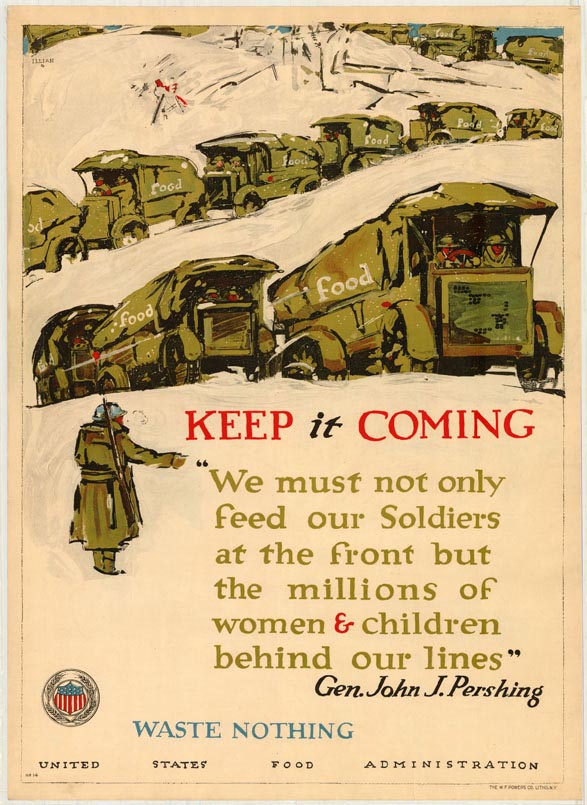
Date: 1918
Creator: The W.F. Powers Co. Litho. for the Food Administration, New York
Dimensions: 73.2 x 53.2 cm
Item number: UNL poster 417, Food Administration poster no. 14
Text on poster: “Keep it coming. ‘We must not only feed our Soldiers at the front but the millions of women and children behind our lines’ Gen. John J. Pershing. Waste Nothing.”
Artwork: In the top background of the poster a line of green military trucks labelled “food” is driving down a hill. The line of trucks steers towards the left and then curves to the right approaching the foreground of the poster. On the left side a soldier is depicted standing in a green coat with a rifle slung over his shoulder, his right arm out outstretched. Beside the image of the soldier and underneath the line of trucks is red, green, black and blue text.

Date: 1918
Creator: Food Administration
Dimensions: 72.7 x 52.8 cm
Item number: UNL poster 443, Food Administration poster no. 17
Text on poster: “This is what GOD gives us/ What are you giving so that others may live? Eat less wheat/meat/fats/sugar. Send more to Europe or they will starve.”
Artwork: In the back ground there is a brown wall with a window to the left. Above there are carrots, onions, and corn hanging. Below there is a basket with bananas, tomatoes and oranges. In front of the basket there is a head of cauliflower and a bundle of grapes. To the right are two large pumpkins. To the left of the basket is a brown sack of potatoes. Positioned to the middle-right of the poster is a tan box containing black and red text.
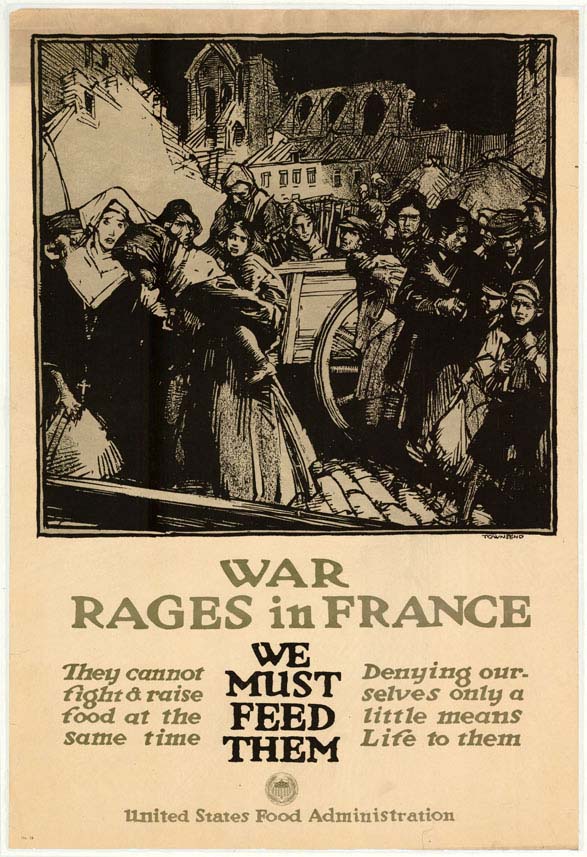
Date: 1918
Creator: Food Administration
Dimensions: 74.5 x 50.8 cm
Item number: Food Administration poster no. 19, UNL poster 451
Text on poster: “War rages in France/ We must feed them. They cannot fight & raise food at the same time. Denying ourselves only a little means Life to them.”
Artwork: In a box that takes up roughly two-thirds of the poster is a black illustration. The illustration depicts a French street being crowded with people. Silhouettes of buildings are in the background. Below the illustration is army green and black text. “We must feed them” is in black text while the rest is army green.
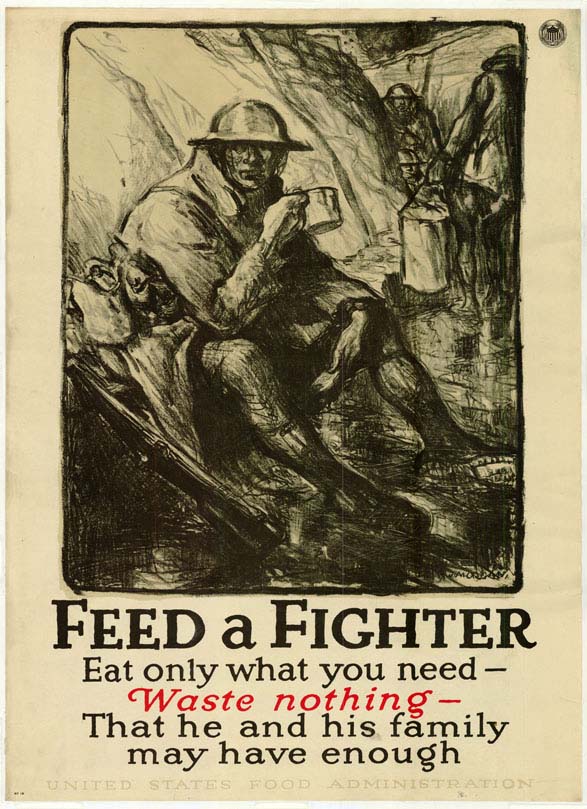
Date: 1918
Creator: The Strobridge Lith. Co. for the Food Administration, Cincinnati and New York
Dimensions: 73.2 x 53.2 cm
Item number: UNL poster 396, Food Administration poster no. 15
Text on poster: “Feed a fighter. Eat only what you need – waste nothing – that he and his family may have enough.”
Artwork: On a tan background the outline of a man is drawn in black on the top three-fourths of the page. The man is depicted to be sitting and is bringing a cup to his face. He is wearing a had and to his left there appears to the the outlines of distant men. Underneath this image is text. “waste nothing -” is in red, while the rest of the text is red.
Date: 1918
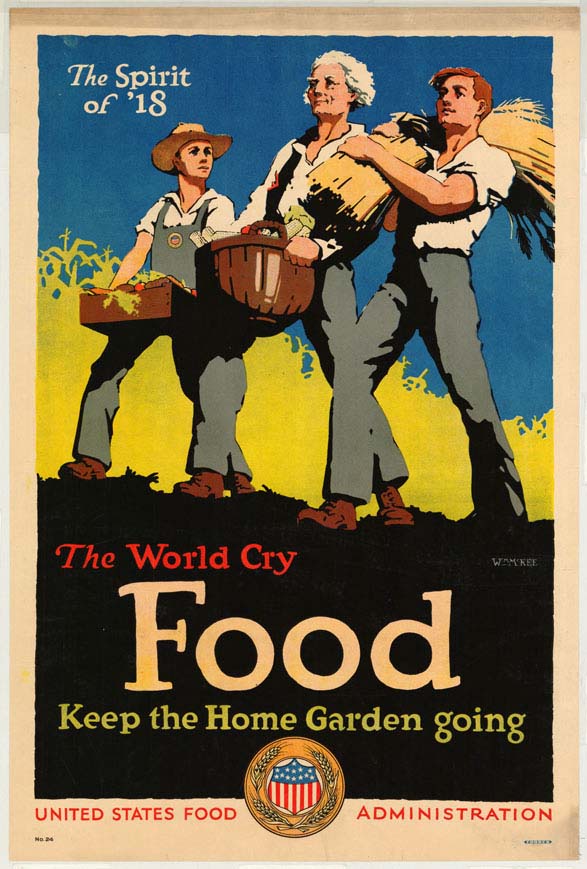
Creator: Forbes for the Food Administration, Boston
Dimensions: 75.2 x 50.3 cm
Item number: UNL poster 439, Food Administration poster no. 24
Text on poster: “The spirit of ’18. The world cry food / Keep the Home Garden going.”
Artwork: In the background a blue sky is depicted at the top, a yellow outline of wheat is depicted in the middle, and on the bottom black ground is depicted. Standing on the ground are three white men. The man on the left is wearing a white shirt under grey overalls with a tan hat. He is carrying a box that appears to have carrots in it. In the middle is an older man with white hair, a white shirt, and grey pants. He is carrying a round basket. To the left is a younger man with brown hair wearing white shirt and grey pants. He is carrying a bundle of wheat over his left shoulder. All three men are wearing brown shoes. Below the men the text is depicted. “The world cry” is red, “food” is tan, and “keep the home garden going” is a yellow-green shade. In the top left corner of the blue sky “The spirit of ’18” is depicted in tan text.
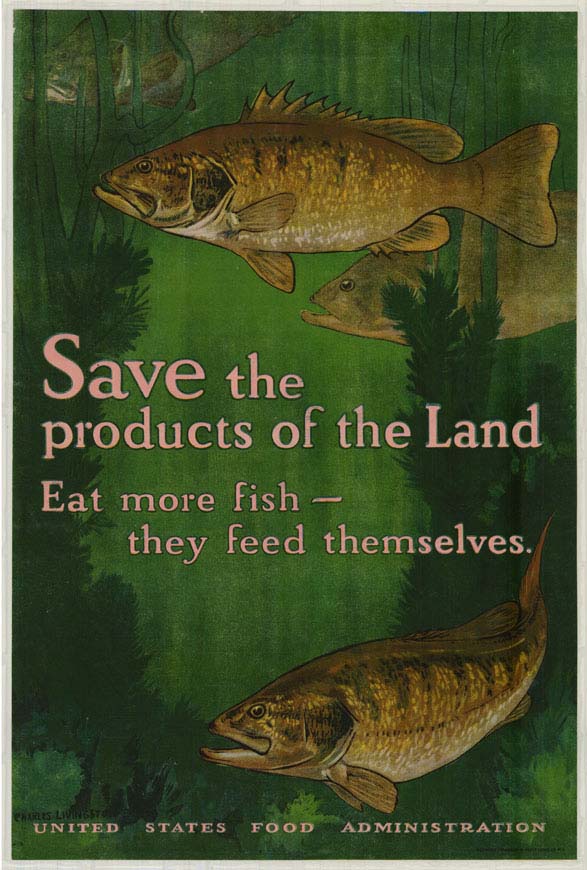
Date: 1918
Creator: Heywood Strasser & Voigt Litho. Co. for the Food Administration, New York
Dimensions: 75 x 50.2 cm
Item number: UNL poster 433, Food Administration poster no.13
Text on poster: “Save the products of the Land / Eat more fish – they feed themselves.”
Artwork: Behind the text is a dark green underwater background with plants. There are four tan and dark brown fish depicted. Three are depicted on the top and one on the bottom. In the middle of the poster the text is a salmon pink color.
Miscellaneous Food and Drink Posters
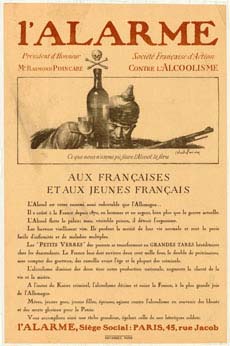
Date: 1914 or 1915
Creator: Paris: Devambez
Dimensions: 49.5 x 32.4 cm
Item number: UNL poster 130
Text on poster: “L’AlARME/ President d’Honneur/ Societe Francaise d’Action/ Mr. Raymond Poincare/ Contre L’Alcoolsme/ Ce que nous n’avons pu faire l/Alcool le fera/ Aux Francaises/ Et aux jeunes fraicais/ L’Alcool est votre ennemie aussi redoutable que l’Allegmagne… Il a coute la France depuis 1870, en hommes et en argent, bien plus que la guerre actuelle. L’Alcool flatte le palais; mais, veritable poison, il detruit l’organisme. Les buveurs vieillissent vite. Ils perdent la moitie de leur vie normale et sont la proie facile d’infirmites et de matadies multiples. Les “PETITS VERRES” des parents se transforment en GRANDES TARES hereditaires chez les descendants. La France leur doit environ deux cent mille fous, le double de poitrinaires, sans compter des goutteux, des ramollis acant l’age et la plupart des criminels. L’alcoomlisme diminue des deux tiers notre production nationale, augmente la cherte de la vie et la misere. A l’instar du Kaiser ciminel, l’alcoolisme decime et ruine la France, a la plus grande joie de l’Allegmagne. Meres jeunes gens jeunes filles, epouses, agissez contre l’alcoolisme en souvenir des blesses et des morts gloriex pour la patrie. Vous accomplires ainsi une tache grandiose, egelant celle de nos heroiques soldats. l’Alarme, Siege Social: PARIS, 45, rue Jacob”
Artwork: The text is depicted in red and black. Towards the top of the poster is an illustration of a wine bottle with a wine glass next to it. Above the bottle a skull and cross bones is depicted. Behind the bottle a soldier is seen with an angry look on his face and a rifle in his hand.

Date: 1917
Creator: Crété Imp., Paris
Dimensions: 113.5 x 74.2 cm
Item number: UNL poster 184
Text on poster: “Ah! Quand supprimera-t-on l’Alcool? (translation: Ah! When will alcohol be banned?)”
Artwork: A man with a black beard and shaggy hair is depicted sitting at a table. He is clutching a bottle of alcohol and has a cup in front of him on the table. To his right is a woman wearing a white dress. She is outreaching her left hand to the man while covering her face with her right hand as if she’s weeping. Cowering behind the woman on her left side is a young girl in a red dress, and to the right behind the woman is a young boy. Above the illustration is red and black text.
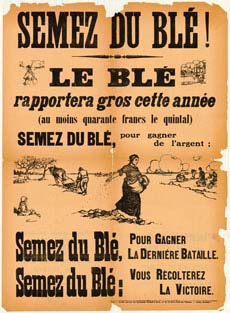
Date: Undated
Creator: Société Anonyme des Imprimeries Wellhoff et Roche, Paris
Dimensions: 74.6 x 54.8 cm
Item number: UNL poster 66
Text on poster: “Semez du blé! Le blé rapportera gros cette anné (au moins quarante francs le quintal) Semez du blé, pour gagner de l’argent; semez du blé, pour gagner la derniere bataille. Semez du blé: vous recolterez la victoire.”
Artwork: In the middle of the poster a woman is seen sprinkling seeds in a pasture. Beside her is a child and behind her are men plowing the land with horses. The text is bold and black.
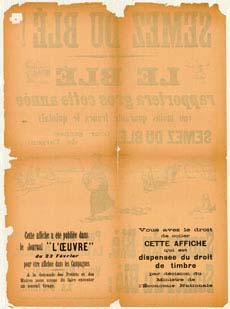
Date: Undated
Creator: Société Anonyme des Imprimeries Wellhoff et Roche, Paris
Dimensions: 74.6 x 54.8 cm
Item number: UNL poster 66
Artwork: Backside of the poster by C. Hautot that encourages people to sow wheat.
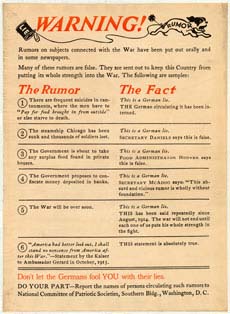
Date: Undated
Creator: National Committee of Patriotic Societies
Dimensions: 72.9 x 53 cm
Item number: UNL poster 124
Text on poster: “Warning! Rumors on subjects connected with the War have been put out orally and in some newspapers. Many of these rumors are false. They are sent out to keep this Country from putting its whole strength into the War. The following are examples:
The Rumor: 1. There are frequent suicides in cantonments, where the men have to “pay for food brought in from outside” or else starve to death. The fact: This is a German lie. The German circulating it has been interned. 2. The steamship Chicago has been sunk and thousands of soldiers lost. This is a German lie. Secretary Daniels says this is false. 3. The Government is about to take any surplus food found in private houses. This is a German Lie. Food Administration Hoover says this is false. 4. The Government proposes to confiscate money deposited in banks. This is a German lie. Secretary McAdoo says: ‘this absurd and vicious rumor is wholly without foundation.’ 5. The War will be over soon. This is a German lie. This has been said repeatedly since August, 1914. The war will not end until each of of us puts his whole strength in the fight. 6. ‘America had better look out. I shall stand no nonsense from America after this War’ -Statement by the Kaiser to Ambassador Gerard in October, 1915. This statement is absolutely true. Don’t let the Germans fool YOU with their lies. Do your part-Report the names of persons circulating such rumors to National Committee of Patriotic Societies, Southern Bldg., Washington, D.C.”
Artwork: In large red writing “Warning!” is displayed on the top of the poster. Underneath is a string can phone attached to a dog. The can says “lie” on it and the dog says “rumor” on it. Below are two columns, one labelled “The Rumor” and the other “The Fact” in red text. Below text is all in black. Toward the bottom of the poster, “Don’t let the Germans fool YOU with their lies” is in red text. The rest is in black.
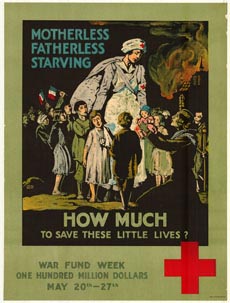
Date: 1918
Creator: Red Cross
Dimensions: 68.8 x 51.8 cm
Item number: UNL poster 421
Text on poster: “Motherless / Fatherless / Starving / How Much to Save These Little Lives? War Fund Week / One Hundred Million Dollars / May 20th-27th”
Artwork: Inside a green border, a scene with two red cross nurses and multiple children is depicted. One woman clothed in a white dress and nurse’s hat is standing in the middle. Around her many children are looking up; some are holding the French flag. In the bottom right corner the second woman is kneeling with her arms outstretched to the children. She is holding a doll with a pink dress and a blue bonnet. On the bottom right is a red cross symbol.
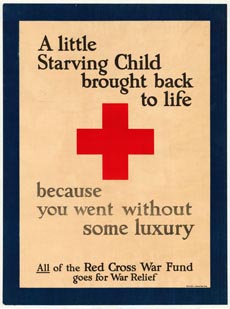
Date: 1918
Creator: Red Cross
Dimensions: 61.2 x 44 cm
Item number: UNL poster 420
Text on poster: “A little starving child brought back to life because you went without some luxury. All of the Red Cross War Fund goes for War Relief.”
Artwork: A thick black border surrounds the poster. Inside the border, the poster is a tan color. In the middle there is a large red cross. Text is written in black.
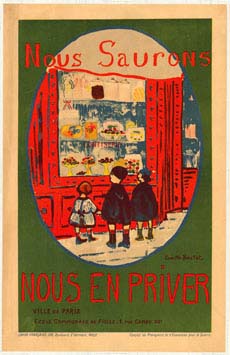
Date: 1917 or 1918
Creator: Union Française; Comité National de Prévoyance et d’Economies, Paris
Dimensions: 54.5 x 35.1 cm
Item number: UNL poster 222
Text on poster: “Nous saurons nous en priver (translation: we will be able to deprive ourselves)”
Artwork: An oval framed by a green rectangle contains an illustration of three children staring into the large window of a candy store. The store’s walls are red. Above and below the illustration is red text.
Artist: Camille Boutet

Artist: S. Vincent
Date: 1917 or 1918
Creator: Union Française; Comité National de Prévoyance et d’Economies, Paris
Dimensions: 54.4 x 33.5 cm
Item number: UNL poster 221
Text on poster: “Ne pas gaspiller le pain est notre devoir (translation: It is our duty not to waste bread)”
Artwork: On a blue background a floral pattern with red flowers depicted in the left and right corner frames a central, circular illustration. The circle in the center contains an illustration of a loaf of bread. One slice of the bread is cut off and laying to the right. Below the circle with the bread is red text on top of a green floral background.
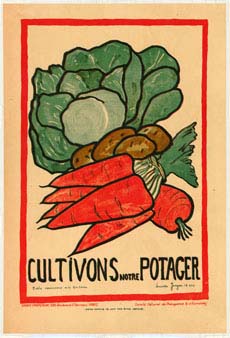
Date: 1917 or 1918
Creator: Union Française; Comité National de Prévoyance et d’Economies, Paris
Dimensions: 56.4 x 37 cm
Item number: UNL poster 195
Text on poster: “Cultivons notre potager (translation: Let us farm our garden)
Artwork: Inside a red border an illustration of vegetables is depicted. In the back is a head of green lettuce. In front of the lettuce are four brown potatoes. In front of the potatoes are six orange carrots. Five of the carrots are tied together at the top and one carrot is on the right side.

Date: 1917 or 1918
Creator: Union Française; Comité National de Prévoyance et d’Economies, Paris
Dimensions: 55.1 x 37.2 cm
Item number: UNL poster 243
Text on poster: Ville de Paris / Je suis brave poule de guerre Je mange peu et produis beaucoup (translation: I am a good war chicken, I eat little and produce a lot)”
Artwork: On a blue and brown background, a black chicken is depicted as laying on a large pile of eggs. Below is text in dark blue and yellow.
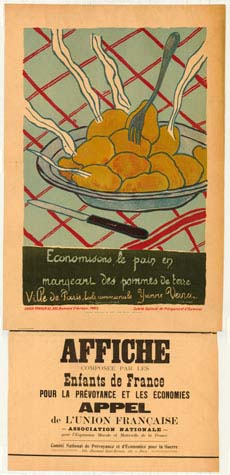
Date: 1917 or 1918
Creator: Union Française; Comité National de Prévoyance et d’Economies, Paris
Dimensions: 55.4 x 37.5 cm
Item number: UNL poster 198
Text on poster: “Economisons le pain en mangeant des pommes de terre (translation: Save bread by eating potatoes)”
Artwork: On top of a red and white tablecloth a plate of full of yellow potatoes is depicted. A fork is sticking out of the top and steam is coming off of the potatoes. To the left of the plate a knife is laying on the tablecloth. Below the illustration is white text on a black background.
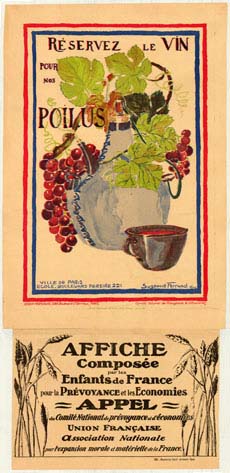
Date: 1917 or 1918
Creator: Union Française; Comité National de Prévoyance et d’Economies, Paris
Dimensions: 54.6 x 37.5 cm
Item number: UNL poster 240
Text on Poster: “Réservez le vin pour nos poilus (Translation: Keep wine for our poilus)”
Artwork: Inside a red and blue border a jug and a cup are depicted. The jug is red and has vines and grapes along the side. The cup is placed to the right and is filled with red wine.
YMCA Posters
The posters bearing the red (or blue) triangle, the symbol of the YMCA (or YWCA), are divided into two categories: Les Foyers du Soldat and all the others.
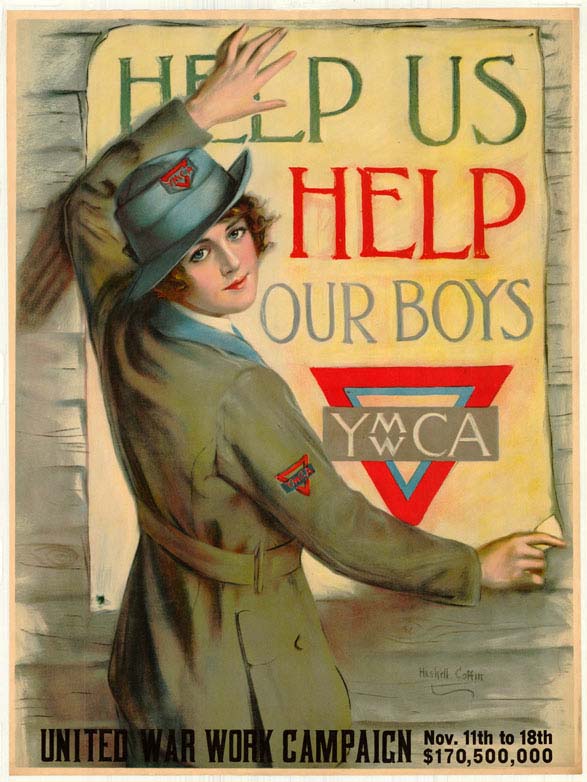
The “others” are a heterogeneous group in many ways—authored by many artists, printed at home or abroad—but nonetheless form a cohesive and representative whole. They call for service on all fronts, for donations, for sacrifice, and are in many ways typical of American poster propaganda during this period. Most interesting among these, perhaps, though not unique in American poster design at this time, are posters 128 and 410. Both feature propaganda within propaganda (“in vitro” propaganda): poster 410 shows a YMCA girl posting a YMCA poster, and poster 128 advertises a war film—“Your boy in the movies!” The kind of double vision, as produced in poster 410 in particular, gives a much greater depth to the piece, as well as an amusing, deliberate and self-aware, twist.
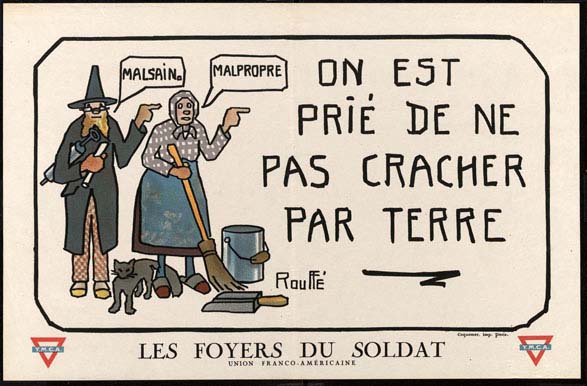
The Foyers du Soldat (Union Franco-Americaine) collection features fascinating, sometimes strange, graphically poor posters. The Franco-American Union, concerned with the welfare of the French poilu, advertises the YMCA-run “foyer” (a hard to translate word with all the connotations of “home” in English) as a refuge. Inside, man escapes the battlefield. Contrasted to bleak snowy landscapes (poster 337) or destroyed urban scenes (poster 334), the bright lights in the foyers welcome the returning soldier. But it is not enough to come home: the bearded soldiers must be civilized, and taught not to spit on the ground (poster 48), for example. Though Post Traumatic Stress Disorder did not exist as a term or medical concept at the time, these posters recognize that soldiers are damaged by war and alienated from society and loved ones.

YMCA and YWCA Posters
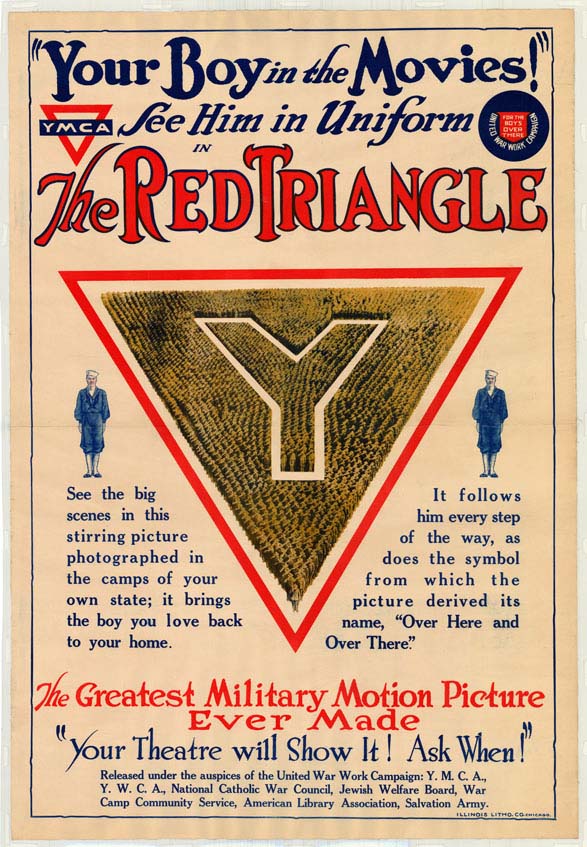
Date: Undated
Creator: Illinois Litho. Co. for the YMCA, Chicago
Dimensions: 103.5 x 70.6 cm
Item number: UNL poster 128
Text on poster: “Your boy in the movies! See him in uniform in the red triangle. See the big scenes in this stirring picture photographed in the camps of your own state; it brings the boy you love back to your home. It follows him every step of the way, as does the symbol from which the picture derived its name, “Over Here and Over There.” The greatest military motion picture ever made. “Your theatre will show it! Ask when!” Released under the auspices of the United War Campaign: Y.M.C.A., Y.M.C.A National Catholic War Council, Jewish Welfare Board, War Camp Community Service, American Library Association, Salvation Army”
Artwork: In the middle of the poster an aerial picture of trees in the shape on an upside down triangle is depicted. In the middle of this is the letter Y. It is surrounded by a red outline. On both the left and right side of the triangle is a boy in a blue uniform. The text is depicted in red and blue.

Date: 1918
Creator: United States Printing and Litho. CO for the YWCA, New York
Dimensions: 105.5 x 70.2 cm
Item number: 400
Text on poster: “For every fighter a woman worker/ Back our second line of defense/ YWCA/ United War Work Campaign”
Artwork: A long line of women are depicted marching in various uniforms. Many of them are holding various tools.
Date: 1918
Creator: American Lithographic Co. for the YWCA, New York
Dimensions: 102.6 x 74.5 cm
Item number: UNL poster 401
Text on poster: “For every fighter a woman worker / Care for her through the YWCA / United War Work Campaign”
Artwork: In the background is a blue upside down triangle, in front of the triangle a woman is standing. She is dressed in green overalls and a white collared undershirt. She is wearing white shoes and white socks and a green hat. In her left hand she is holding an airplane and in her right hand she is holding an artillery shell.
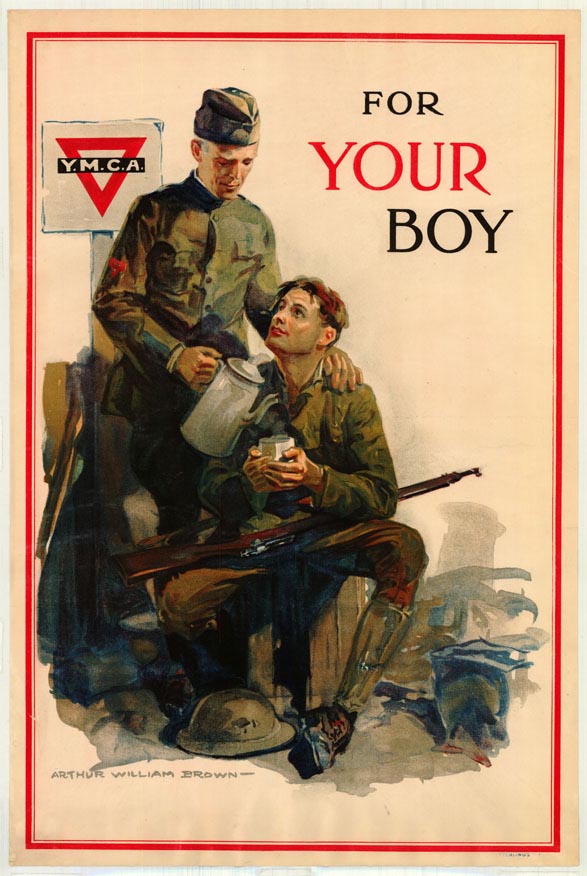
Date: 1918
Creator: Ketterlinus for the YMCA, Philadelphia
Dimensions: 75.1 x 50 cm
Item number: UNL poster 402
Text on poster: “For your boy”
Artwork: Depicted are two men, one man sitting down on a bench and the other standing over to the left. The man standing has a green jacket and hat and is holding a silver pitcher. The man sitting down is looking up at the man standing, he is wearing a green jacket and brown pants. In his lap is a large rifle. He is holding a cup up to the pitcher that the man standing is holding. Behind the man standing up is a YMCA sign with the red triangle symbol. The poster has a red border.
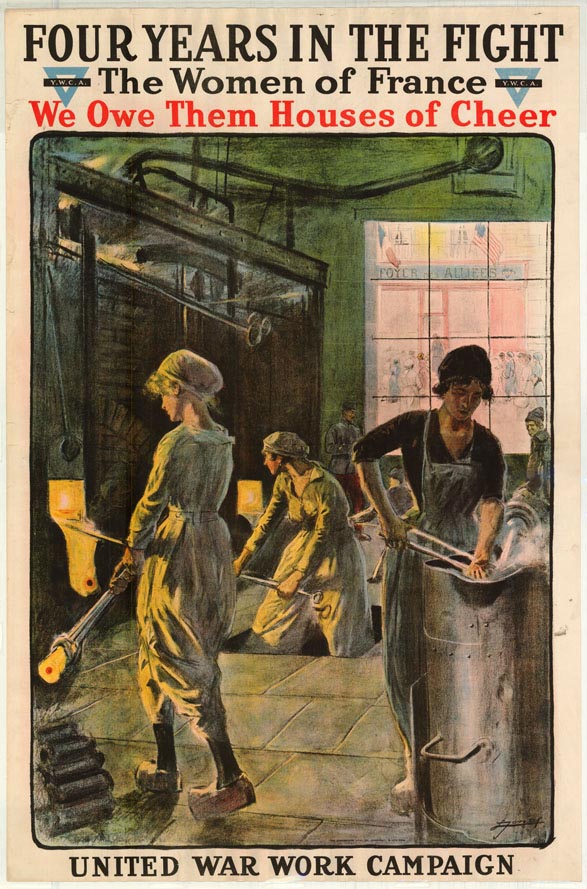
Date: 1918
Creator: The Stribridge Litho. Co. for the YWCA, Cincinnati & New York
Dimensions: 405.3 x 69.6 cm
Item number: UNL poster 403
Text on poster: “Four years in the fight/ Women of France/ We owe them houses of cheer/ United War Work Campaign”
Artwork: Three women are depicted working. The woman on the bottom left hand corner is in a white dress and bonnet. She is holding a clamp in each hand and in the clamps is holding what seems to be orange hot metal. In the bottom right hand corner a woman with a white apron on top of a black dress appears to be cleaning things in a large metal container. In the background centered in the middle is another woman also dressed in a white dress and bonnet. She is holding a clamp with both hands and is pointing it forward. The walls in the background are green. On the top of the poster is black and red text, and on the bottom of the poster is black text.
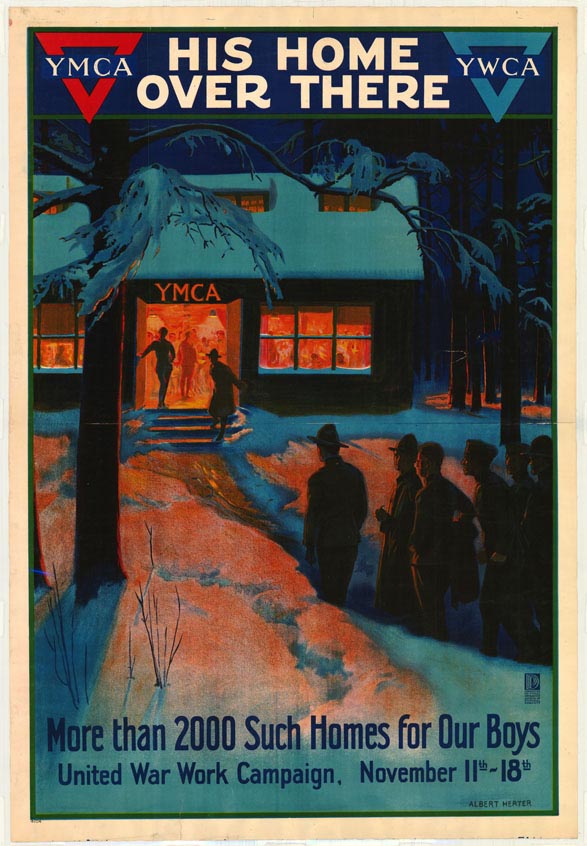
Date: 1918
Creator: YMCA and YWCA
Dimensions: 103.8 x 70.6 cm
Item number: UNL poster 412
Text on poster: YMCA / His home over there / YMCA / More than 2000 such homes for our boys / United War Work Campaign, November 11th – 18th”
Artwork: An illustration of a YMCA building is depicted. The lighting is dark as if it is night, and there is snow on the roof and the ground. Orange light is shining from inside the YMCA building and men are seen standing on the steps leading to the building. Outside the building an down the path tot he right six men are depicted standing outside. Around the building trees are depicted. A red triangle with “YMCA” on it is in the top left corner, and a blue triangle with “YMCA” is on the top right corner. “His home over there” is in white text between the two triangles. Dark blue text is on the bottom of the poster.
Date: 1918
Creator: YMCA and YWCA
Dimensions: 70.2 x 52.6 cm
Item number: UNL poster 410
Text on poster ” Help us help our boys. YMWCA / United War Work Campaign Nov. 11th to 18th $170,500,500″
Artwork: An Illustration of a woman with short auburn hair is depicted as hanging up a YMCA poster. The woman is wearing a blue hat and a green jacket with a blue collar on it. The poster has “help us” in green text, “help” in red text: and “our boys” in grey text. Underneath is the red YMCA triangle symbol. On the bottom of the poster “United War Work Campaign Nov. 11th to 18th $170,500,000” is written in black.
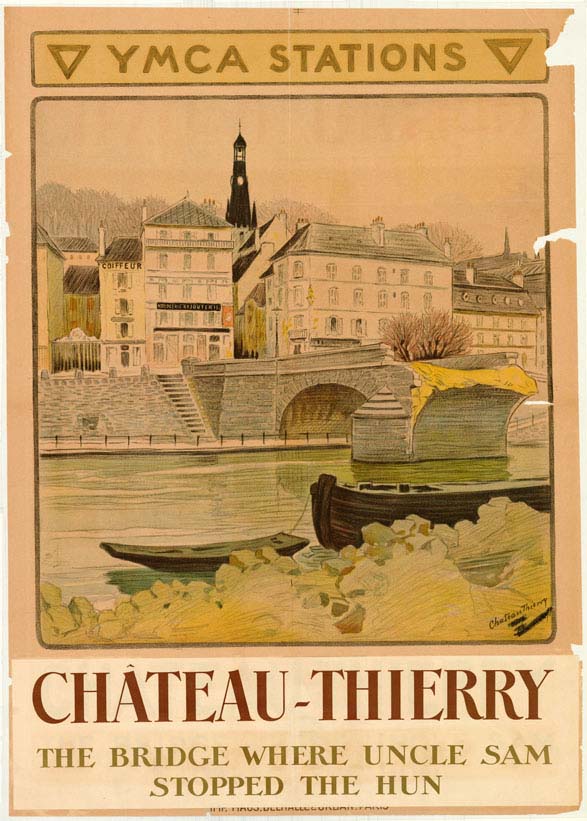
Date: ca. 1918 (drawing is dated 1915)
Creator: Imp. Maus, Delhalle & Ubran, Paris
Dimensions: 107 x 75.8 cm
Item number: UNL poster 453
Text on Poster: “YMCA stations / Chateau-Thierry / The bridge where Uncle Sam stopped the Hun
Artwork: On the top of the poster a yellow box with two triangles at the sides says “YMCA stations” in the middle. Below is an illustration of a river. The background before the river depicts various buildings and the beginning of a bridge that is broken in the middle. In the foreground across the river a boat is depicted along with some shrubbery. Below the illustration is red and green text.
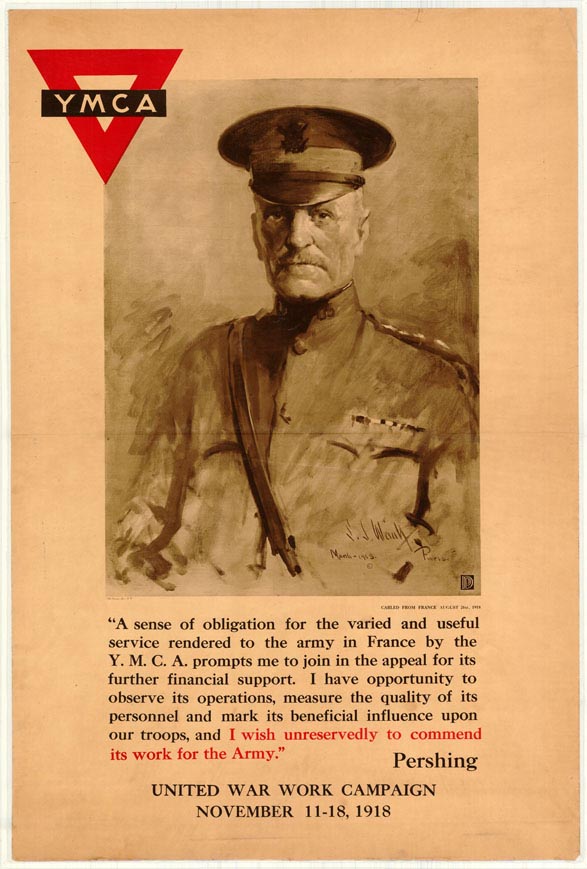
Date: 1918
Creator: Alco Gravure, Inc. for the YMCA
Dimensions: 83 x 51.6 cm
Item number: UNL poster 435
Text on poster: “YMCA / ‘A sense of obligation for the varied and useful service rendered to the army in France by the Y.M.C.A. prompts me to join in the appeal for its further financial support. I have the opportunity to observe its operations, measure the quality of its personnel and mark its beneficial influence upon our troops, and I wish unreservedly to commend its work for the Army.’ Pershing / United War Work Campaign / November 11-18, 1918”
Artwork: In the left hand corner an upside-down red triangle is depicted with “YMCA” written on it. In the center of the poster an illustration of Pershing is depicted. He is in his army uniform with a hat, buttoned-up jacket, and a strap around his left shoulder. Below the illustration is the text. “I wish unreservedly to commend its work for the Army” is red, while the rest of the text is black.

Date: 1918
Creator: United War Work Campaign
Dimensions: 69.8 x 50.5 cm
Item number: UNL poster 449
Text on poster: “United we serve. YMCA / YMCA. National Catholic war council- K. of C. / Jewish Welfare Board / War camp community service / American Library Association / Salvation Army / United war work campaign / $170.500.500.”
Artwork: A red, white and blue outline encloses large red and blue text. On each corner of the border, there is a red circle with “170” inside.
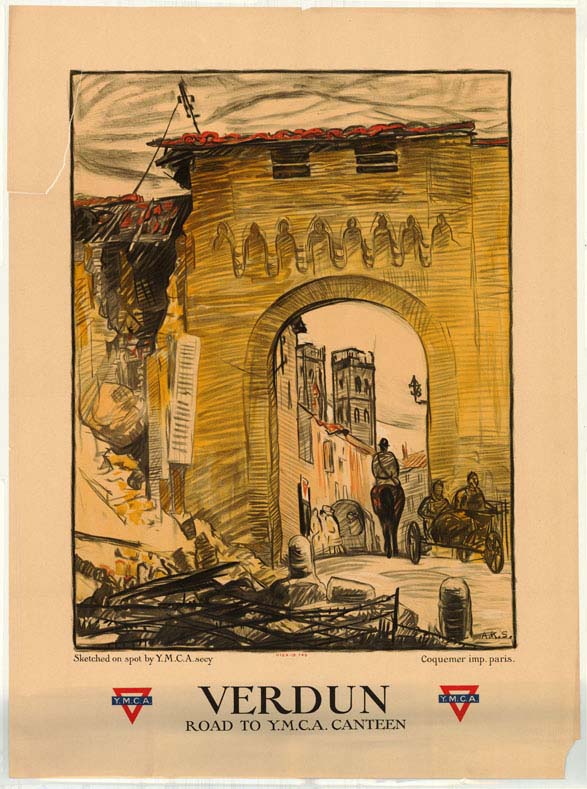
Date: ca. 1918
Creator: Coquemer Imp., Paris
Dimensions: 102.9 x 76.2 cm
Item number: UNL poster 450
Text on poster: “Verdun/ Road to Y.M.C.A. canteen”
Artwork: An illustration of a large arch is depicted in a box with a black outline. The arch is yellow with a red roof. An individual on a horse is depicted walking through the arch. On the other side of the arch building and the outline of a carriage can be seen.
Date: 1918
Creator: YMCA
Dimensions: 66.8 x 49.8cm
Item number: 452
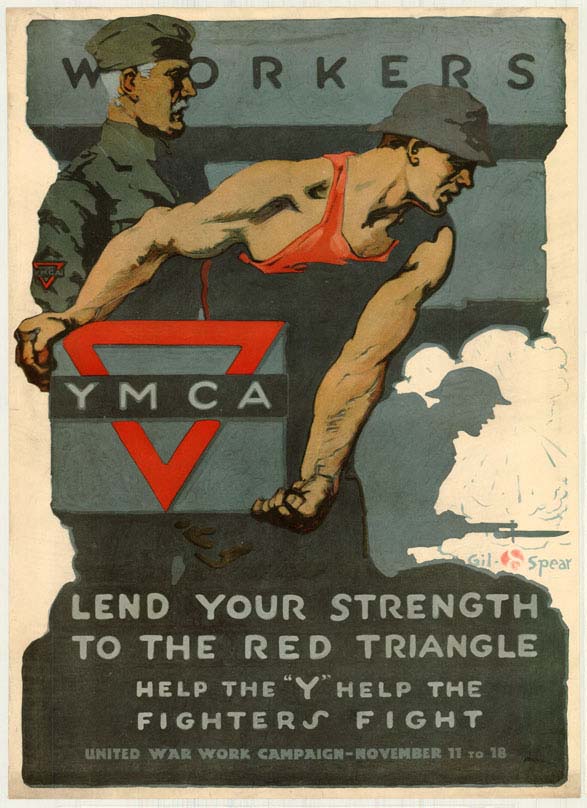
Text on poster: “YMCA / Workers lend your strength to the red triangle. Help the ‘Y’ help the fighters fight. United war work campaign-November 11 to 18”
Artwork: In the top center of the poster a large blue rectangle is depicted with “workers” displayed on it. Below two men are depicted. To the left is an older man with a grey mustache. He is wearing a green hat and a green shirt. To his right is a younger man with a grey hat and a red tank top on. He is holding the YMCA symbol that looks like an upside down red triangle. To his right is the silhouette of a soldier holding a gun. Behind the silhouette is a white cloud.

Date: 1918
Creator: YMCA and YWCA
Dimensions: 103.8 x 70.6 cm
Item number: UNL poster 412
Les Foyers Du Soldat Posters
Date: Undated
Creator: Coquemer Imp., Paris
Dimensions: 31.3 x 48.4 cm
Item number: UNL poster 16
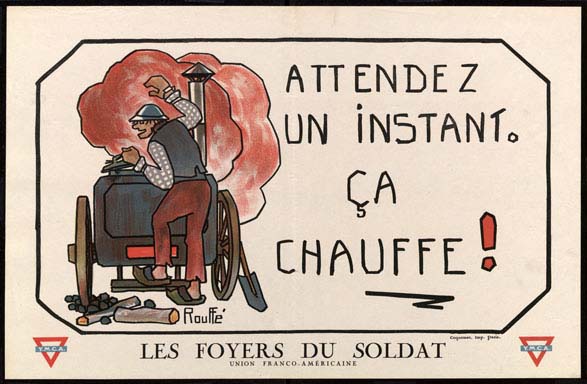
Text on poster: “Attendez un instant. Ça chauffe! (Translation: Wait a moment. It’s heating up!)”
Artwork: On the left a man is pictured working on a stove. The man is wearing a silver hat, a brown checkered shirt underneath a black vest, red pants, and brown loafer shoes. There is red smoke billowing out the side. To the left side of the man there is coal and a couple pieces of wood laying on the ground. To the left is text in black with a red exclamation point.
Your Artist: Rouffé
Date: Undated
Creator: Coquemer Imp., Paris
Dimensions: 31.5 x 48.5 cm
Item number: UNL poster 52
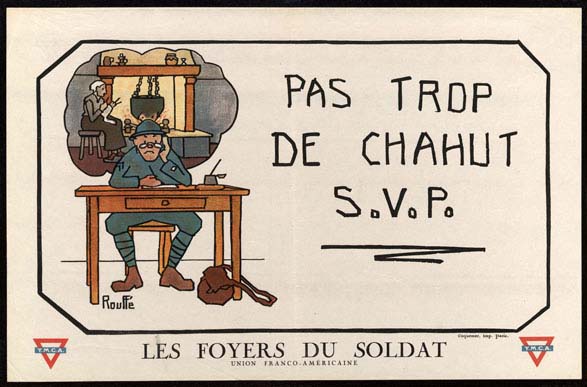
Text on poster: “Pas trop de chahut S.V.P. (Translation: Not too much noise please).”
Artwork: A man is seen sitting at a wooden table in a blue uniform. He may be writing a letter. By his feet a brown bag is laying on the ground. He has one of his hands on his face and a thought bubble of his daydream is depicted above his head. In the thought bubble an older woman tending a fire with a cauldron on it.
Date: Undated
Creator: Coquemer Imp., Paris
Dimensions: 31.3 x 48.4 cm
Item number: UNL poster 46
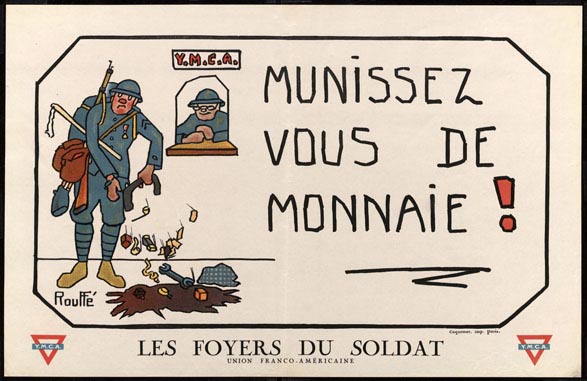
Text on poster: “Munissez vous de monnaie! (Translation: Arm yourself with change!)”
Artwork: To the left a soldier is depicted in a blue uniform. He has a brown bag and is dropping a wrench, and various other objects onto the floor. To the right of his is a man in a window with his arms crossed. Above the man in the window is a “Y.M.C.A. ” sign. To the left of these two men is large black text with a red exclamation point and a black underline.
Date: Undated
Creator: Coquemer Imp., Paris
Dimensions: 31.5 x 48.3 cm
Item number: UNL poster 48
Text on poster: “Malsain/ Malpropre/ On est prié de ne pas cracher par terre (Translation: One is asked not to spit on the ground).”
Artwork: On the left side of the poster a man and a woman are depicted. The man is on the left and is wearing a black pointy hat, glasses, a black jacket, and brown plaid pants. He has a blonde beard that parts in the middle. He has a speech bubble that says “Malsain.” On the right beside him a woman is seen wearing a head scarf and shirt with a grey and white polka dot pattern. She is also wearing a blue apron and red slippers and she is holding a broom. By her left foot there is a black cat. In front of her is a dust pan and to her right is a silver bucket.

Date: 1918
Creator: Atelier Georges Dorival, Paris
Dimensions: 73 x 99.3 cm
Item number: UNL poster 337
Text on poster: “Les Foyers du Soldat / Union Franco_Americaine”
Artwork: A black silhouette of a soldier is pictured in the right corner. He appears to be wearing a helmet and has a rifle slung over his shoulder. Behind him is a blue night sky and a full moon shining. There is snow on the ground and three cabins on the left in the distant background. The limbs of a tree are sticking out of the bottom left frame of the illustration.
Date: Undated
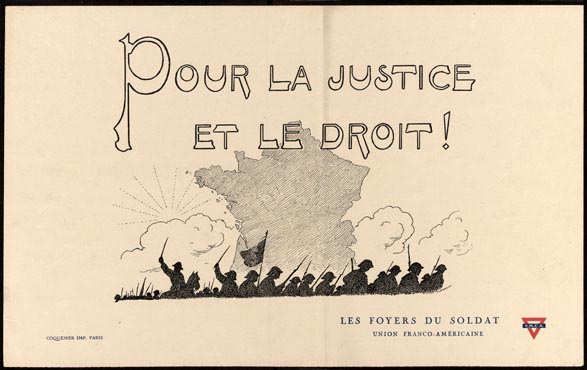
Creator: Coquemer Imp., Paris
Dimensions: 27.7 x 44.6 cm
Item number: UNL poster 57
Text on poster: “Pour la justice et le droit! (Translation: For justice and righteousness!)
Artwork: On the bottom silhouettes of about a dozen soldiers are depicted. The silhouettes are from the waist up, many of the soldiers are holding up with rifles, one is on horseback, and one is holding up a flag. In the background there is a grey outline of France within the clouds.

Date: Undated
Creator: Coquemer Imp., Paris
Dimensions: 28 x 45.3 cm
Item number: UNL poster 9
Text on poster: “Aide-toi, le ciel t’aidera. (Translation: Help youself, the sky will help you).”
Artwork: Two images are pictured on the left side of the poster. The top is a black outline of two horses plowing a field. The bottom one is a black outline of a distant settlement with the sun rising in the background.
Date: Undated
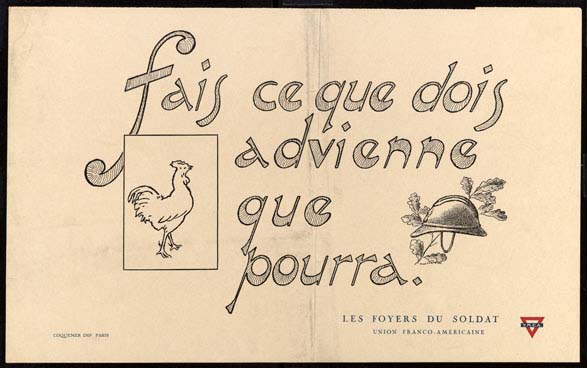
Creator: Coquemer Imp., Paris
Dimensions: 28.1 x 45.3 cm
Item number: UNL poster 38
Text on poster: “Fais ce que dois/advienne que pourra (Translation: Do what you must/ happen what can).”
Artwork: The text is written in very large black and grey font. On the left side an outline of a chicken is pictured inside of a black rectangle. To the right is a black helmet with leaves around it.

Date: 1918
Creator: Coquemer Imp., Paris
Dimensions: 121.2 x 80.8 cm
Item number: UNL poster 350
Text on poster: “Mon cher Foyer, je t’aime tu es la maison de chacun le chex soi pour lous/ UN POILU”
Artwork: A YMCA building is depicted surrounded by a pine forest. The grass is light green and there is a dirt path leading up to the building. There are men scattered outside. All of them are wearing blue uniforms except one man that is wearing a brown uniform. At the bottom of the poster the forest scene fades into grey.

Date: ca. 1918
Creator: Coquemer Imp., Paris
Dimenions: 119.4 x 76.9 cm
Item number: UNL poster 333
Text on poster: “Le Foyer du Soldat est le trait d’union entre la ligne de bataille et la vision de la paix qui rendrea les foyers familiaux Il aide à combattre à vivre, à espérer.”
Artwork: A column is depicted on both sides of the poster. On the top a French and American flag are depicted together in the middle. At the top of each column is a bundle of various other flags.

Date: ca. 1918
Creator: Coquemer Imp., Paris
Dimensions: 104.5 x 74.9 cm
Item number: UNL poster 338
Text on poster: Les Foyers du Soldat / Union Franco Americaine”
Artwork: In the background a village is depicted in front of rolling hills. A dirt path is seen in the middle of the poster that leads to two men. On the left a man is seen in a green army uniform and is carrying a large backpack. On the right is a man in a blue uniform with a cane. These two men are shaking hands. The poster is outlined in a burnt orange color.
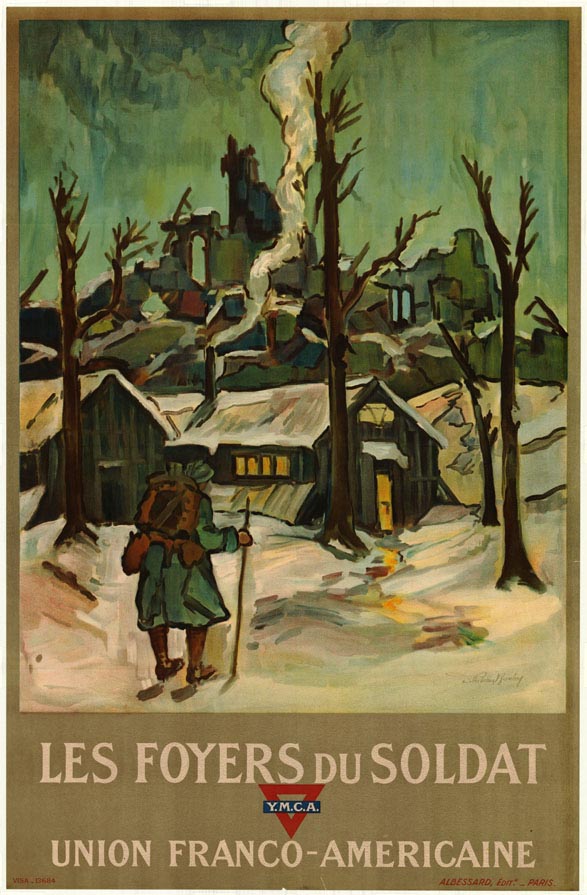
Date: ca. 1918
Creator: Albessard, Editr., Paris
Dimensions: 116.3 x 75.7 cm
Item number: UNL poster 334
Text on poster: “Les Foyers du Soldat / Union Franco-Americaine”
Artwork: A person dressed in a heavy green coat holding a walking stick is seen approaching a small village. There is snow covering the ground and one of the two buildings has the lights on and smoke is billowing from it’s chimney. In the background there appears to be ruins of other larger buildings. The sky is a blue-green color.
Index of Artists
- A.K.S
- Verdun/ Road to the Y.M.C.A. Canteen
- Anonymous
- United we serve
- A Little Starving Child brought back to life because you went without some luxury
- Food and the War! American Wheat to Win!
- Le Foyer du Soldat
- Save/ and serve the cause of freedom
- Warning!
- Baker, Ernest Hamlin
- For every fighter a woman worker/ Back our second line of defense
- Bancroft, Milton
- For every fighter a woman worker/ Back our second line of defense
- Boutet, Camille
- Nous saurons nous en priver
- Brinley, Daniel Putnam
- Les Foyers du Soldat
- Britton, L. N.
- Eat more corn, oats, and rye products
- Brown, Arthur William
- For your boy
- Bull, Charles Livingston
- Save the products of the land/ Eat more fish – they feed themselves
- Chambers, C. E.
- Food will win the war
- Chavannaz, B.
- Ah! Quand supprimera-t-on l’Alcool?
- Christol, Fred
- Pour la justice et le droit!
- Aide-toi, le ciel t’aidera
- Fais ce que dois/ Advienne que pourra
- Coffin, Haskel
- Help us help our boys
- Cooper Fred G.
- Food/ Don’t waste it
- Save a loaf a week – Help win the war
- Save/ and serve the cause of freedom
- Dorival, George
- Les Foyers du Soldat
- Douanne, G.
- Je’suis une brave poule de guerre
- Faivre, Jules Abel
- L’Alarme
- Ferrand, Suzanne
- Réserves le vin pour nos poilus
- Harris, Lawrence
- Mon cher Foyer
- Harrison, Lloyd
- Corn/ The food of the nation
- Wholesome – Nutritious foods from corn
- Hautot, C.
- Semez du blé!
- Hendee, A.
- This is what GOD gives us/ What are you giving so that others may live?
- Herter, Albert
- His home over there
- Illian, George John
- Keep it coming
- Cardinal Mercier has appealed to the Food Administration for more food for starving millions
- Jaeger, Louisette
- Cultivons notre potager
- Jonas, Lucien Hector
- Four years in the fight/ The women of France/ We owe them houses of cheer
- McKee, William
- The world cry food/ Keep the Home Garden going
- McMein, Neysa Moran
- One of the thousand Y.M.C.A. girls in France
- Morgan, Wallace
- Feed a fighter
- O’Nallch
- “Your boy in the movies!”
- Rouffé
- Attendez un instant. Ca chauffe!
- Munissez vous de monnaie!
- On est prié de ne pas cracher par terre
- Pas trop de chahut S. V. P.
- Sheridan, John E.
- Food is ammunition – Don’t waste it
- Spear, Gil
- Workers lend your strength to the red triangle
- Stahr, Paul
- Be patriotic/ Sign your country’s pledge to save the food
- Steele
- Defeat the Kaiser and his U-Boats
- Townsend, Harry Everett
- War rages in France/ We must feed them
- Treidler, Adloph
- For every fighter a woman worker/ Care for her through the YWCA
- Vernet, Yvonne
- Economisons le pain en mangeant des pommes de terre
- Vincent, S.
- Ne pas gaspiller le pain est notre devoir
- Wavshawsky, A. G.
- Les Foyers du Soldat Poster
- Woolf, S. J.
- Pershing
- Young, Crawford
- Sir – don’t waste while your wife saves/ Adopt the doctrine of the clean plate
Bibliography
Crawford, Anthony R. Posters of World War I and World War II in the George C. Marshall Research Foundation. Charlottesville: The University Press of Virginia, 1979.
Dickson, Maxcy Robson. The Food Front in World War I. Washington D.C.: American Council on Public Affairs, 1944.
Paret, Peter, Beth Irwin Lewis, and Paul Paret. Persuasive Images, Posters of War and Revolution from the Hoover Institution Archives. Princeton, NJ: Princeton University, c1992 .
Rawls, Walton. Wake Up America! World War I and the American Poster. New York: Abbeville Press, 1988.
Rudolph, G.A. War Posters from 1914 through 1918 in the Archives of the University of Nebraska-Lincoln. University of Nebraska Studies series no. 69. Lincoln: University at Lincoln, 1990.
Shillinglaw, David Lee. An American in the Army and YMCA, 1917-1920. The Diary of David Lee Shillinglaw. Edited by Glen E. Holt. Chicago: University of Chicago, 1971.
Acknowledgements
Yale University graduate student Gene M. Tempest created this website as part of a summer 2007 internship with the University of Nebraska-Lincoln Libraries. The site was migrated and updated by Alexis Thomas as part of a summer 2020 Schmidt Family Libraries Internship.